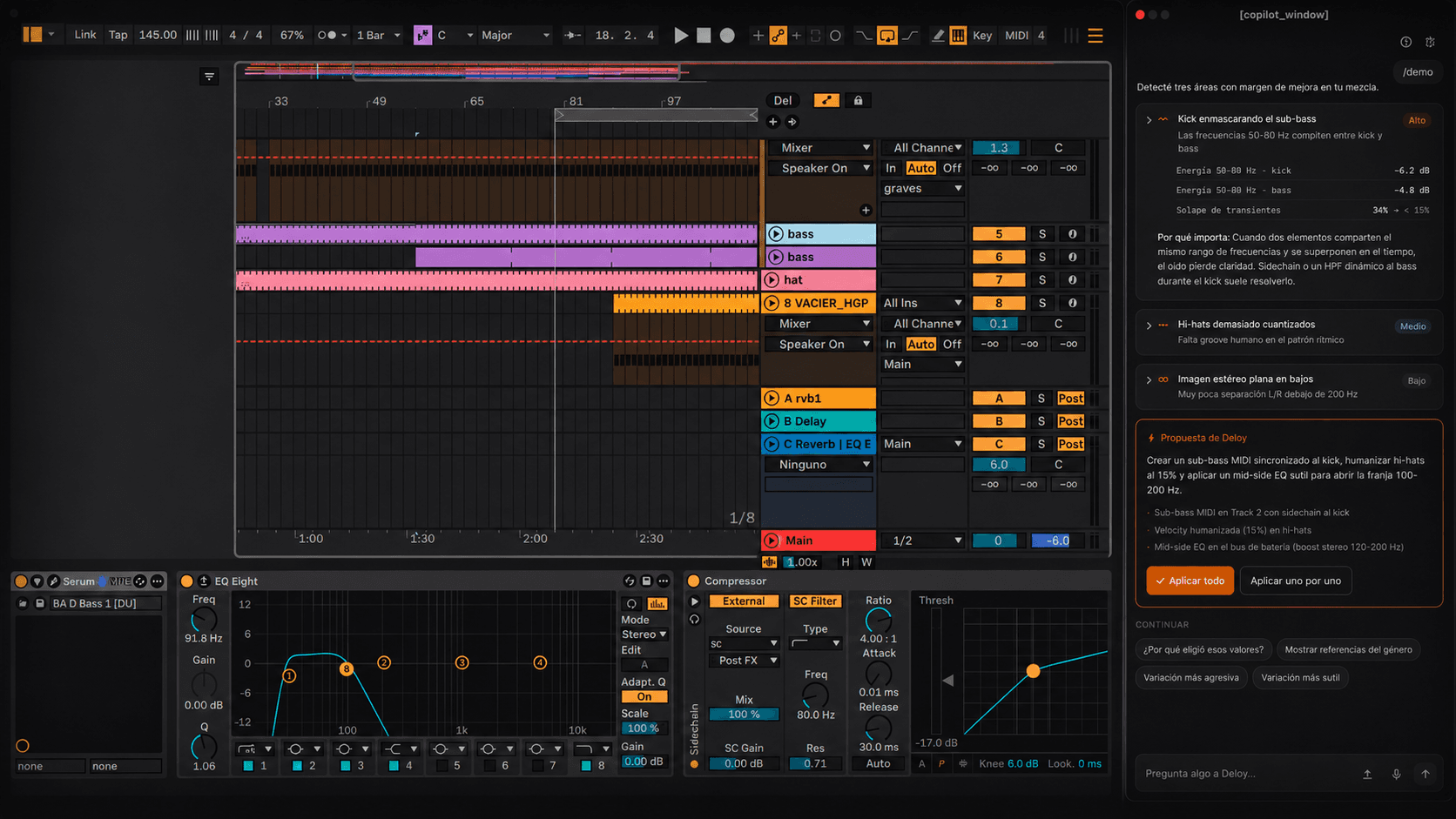
When we started designing Deloy, the most obvious question was where it had to live. A web app was the easy answer: clean dashboard, fast deploy, clear metrics. But after spending twenty hours in the studio doing discovery with producers, the answer changed.
The studio is a system of habits
A producer who already has a routine with Ableton doesn't want another window open. They don't want to alt-tab between the session and a browser. Every interruption of the flow costs. And tools that feel external to the studio end up abandoned — not because they're bad, but because they break the context.
Deloy as Max for Live
That's why Deloy is a Max for Live plugin. It lives as one more device in your rack. You call it inside the session, it answers inside the session, and when you close Ableton it closes with you. There's no separate service to remember, no dashboard to check, no profile to maintain. It's a tool that exists when you produce and disappears when you don't.
What we gave up
Living inside Ableton isn't free. We lose fine-grained usage analytics, we lose speed iterating on the UI, we lose some web integrations. But we gain the only thing that matters when a production tool is seriously evaluated: that it gets used every day without thinking.
This isn't ideology, it's respect for the workflow
We're not saying every music AI tool has to live in a DAW. There are cases where a web dashboard makes sense — A&R, publishing, sync. But the creative moment, the moment a producer is building, is sacred. And our responsibility is not to interrupt it.