Two or three years ago, talking about AI in music meant talking about a threat or a toy. Today it's neither. It's infrastructure.
I want to pause and make sense of what's really happening, with data and without hype. Not to scare anyone or to sell optimism, but because I believe we're at a hinge moment: the rules for how AI will work in music for the next ten years are being written now. And it's worth understanding them.
I'll split this into five parts: who's using AI, how much the market moves, what the platforms did, the underlying legal problem, and where I think it's all heading.
1. Adoption already happened. The debate is behind us.
The clearest fact of 2026 is that the discussion about "whether" creators are going to use AI is over. They use it.
A survey of 1,200 music creators found that 87% have already incorporated AI into at least one part of their process, from composition to promotion. And it's not a music-only phenomenon: a broader survey of 6,500 creators of all kinds yielded exactly the same number, 87%, with more than 40% using it daily.
But here comes the important nuance, and it's the one that interests me most. The way they use it isn't "press a button and out comes a song". The dominant trend is what's called a hybrid workflow: AI for speed and repetitive tasks, human judgment for the decisions, the interpretation and the emotional weight.
In fact, one of the most repeated observations among music supervisors and reviewers of professional libraries is that fully automated tracks tend to fail. They don't meet expectations, they lack intention. What works is human creative direction assisted by AI, not automatic generation with human selection at the end. That distinction —who directs and who assists— will come up several times in this text, because it's the one that defines everything.
The question stopped being whether AI will be in music. The only question left is who directs: the human or the machine.
2. The market: from toy to category
The numbers track the adoption. The global generative-AI-in-music market was valued at around 642 million dollars in 2024 and is projected to reach some 3 billion by 2030, growing at a rate close to 30% annually.
Behind that figure there's a reshuffling of the big players worth watching:
The generation platforms that grabbed the headlines —Suno, Udio— didn't come out of nowhere. They were built on years of open research, with models like Meta's MusicGen and Stability AI's Stable Audio. Suno, with its Studio version, stopped being a novelty and started working more like a generative workstation: multitrack, BPM control, stem and MIDI export to keep working in your DAW. It's telling how its own CEO frames it: that Studio was built to expand the musician's toolbox, and that it deliberately doesn't prescribe workflows, so human talent stays at the front.
On the other side, the major labels went from suing to integrating. Spotify announced it was partnering with the major labels, Believe and Merlin, to build AI tools. Splice, beloved by a whole generation of producers as a sample library, acquired a voice-model company and partnered with Universal to develop AI virtual instruments. Universal and Sony, the same ones litigating, also collaborate with companies that use forensic AI to protect artists from rights infringement.
The underlying message is clear: AI in music stopped being a niche category and became part of the core strategy of the industry's biggest companies.
3. The platforms set the rules (and they're about transparency)
This is, for me, the most important part of 2026. And the one that most confirms the direction I chose to build Deloy in.
During 2024 and 2025, the avalanche of uncontrolled generated music created a serious problem for streaming platforms. The figures are brutal: Deezer reports receiving more than 30,000 fully AI-generated tracks every day. Spotify, for its part, removed more than 75 million tracks it classified as "spam" over twelve months, many of them low-effort AI content used for streaming fraud.
Faced with that, the platforms didn't ban AI. They did something more interesting: they started requiring transparency.
In September 2025, Spotify adopted the DDEX standard for AI disclosure, a standardized metadata framework to label AI's participation in the creation of a track. Apple Music launched its "Transparency Tags" in March 2026, a metadata system to flag AI's participation. Apple, moreover, only allows uploading AI music from verified creators who meet data-consent standards.
And what the platforms asked for converged on three central requirements:
Disclosure: the user must label whether the track is AI-generated or AI-assisted. Provenance: documentation on origin and licenses is increasingly required. Human authorship: platforms with the highest editorial standards, like Tidal, reserve their features for works with verified human authorship.
Notice the pattern. None of these rules say "AI is forbidden". They all say, at heart, the same thing: show what you did and how you did it. The emerging standard isn't prohibition. It's transparency.
4. The legal problem no one can dodge
Here's the knot, and it's where things get serious for anyone who publishes music.
In most jurisdictions —the United States and the European Union included— AI-generated audio isn't protectable by copyright as an independent work without substantial human creative input. Put simply: if you generate a track entirely with a tool and there's no real human creative direction, in many places you can't register that music as yours. Anyone could use it.
This has an uncomfortable practical consequence. When you upload music to a distributor, you usually confirm —by checking a box— that you own all the rights to the content. For many purely generated tracks, that confirmation is legally incorrect. And there it's not just a detection risk: it's that you're creating a contractual breach with the distributor through a false statement. That's what gives platforms the basis to take down tracks and withhold royalties.
The legal landscape keeps moving. There are key rulings expected in 2026 —like UMG vs. Suno, expected in the northern summer, and GEMA vs. Suno in June— that could redraw the map. The pressure all points in the same direction: training AI on copyrighted works will probably require some form of authorization or compensation, and the EU AI Act already requires transparency about AI's participation.
The conclusion of practically every serious legal analysis is the same, and I quote it because it's central: the more your workflow looks like "human creative direction with AI assistance" than "AI generation with human selection", the better your legal position.
Once again, the same distinction. Who directs.
5. Where this is heading (and where I stand)
If I put all the pieces together —mass adoption, growing market, platforms demanding transparency, law rewarding human authorship— the picture that emerges is fairly coherent. And it goes in a single direction.
Transparency will stop being optional and become mandatory. The EU AI Act already requires it. Copyright offices require it to register. Platforms ask for it to distribute. It's not a fad; it's the path regulators, courts and platforms are already taking at the same time.
Human authorship will be an asset, not a formality. In a world where Deezer receives 30,000 generated tracks per day, what's scarce —and therefore valuable— will be the music where you can prove a person was directing. Creators associated with ethical generation tools already stand out in credibility. That will grow.
And new roles will appear. Surveys of creative professionals already anticipate the formalization of positions that didn't exist two years ago: AI creative directors, curators, strategists who translate the human vision into precise direction for the models. The human doesn't disappear from the process. They move to the director's chair.
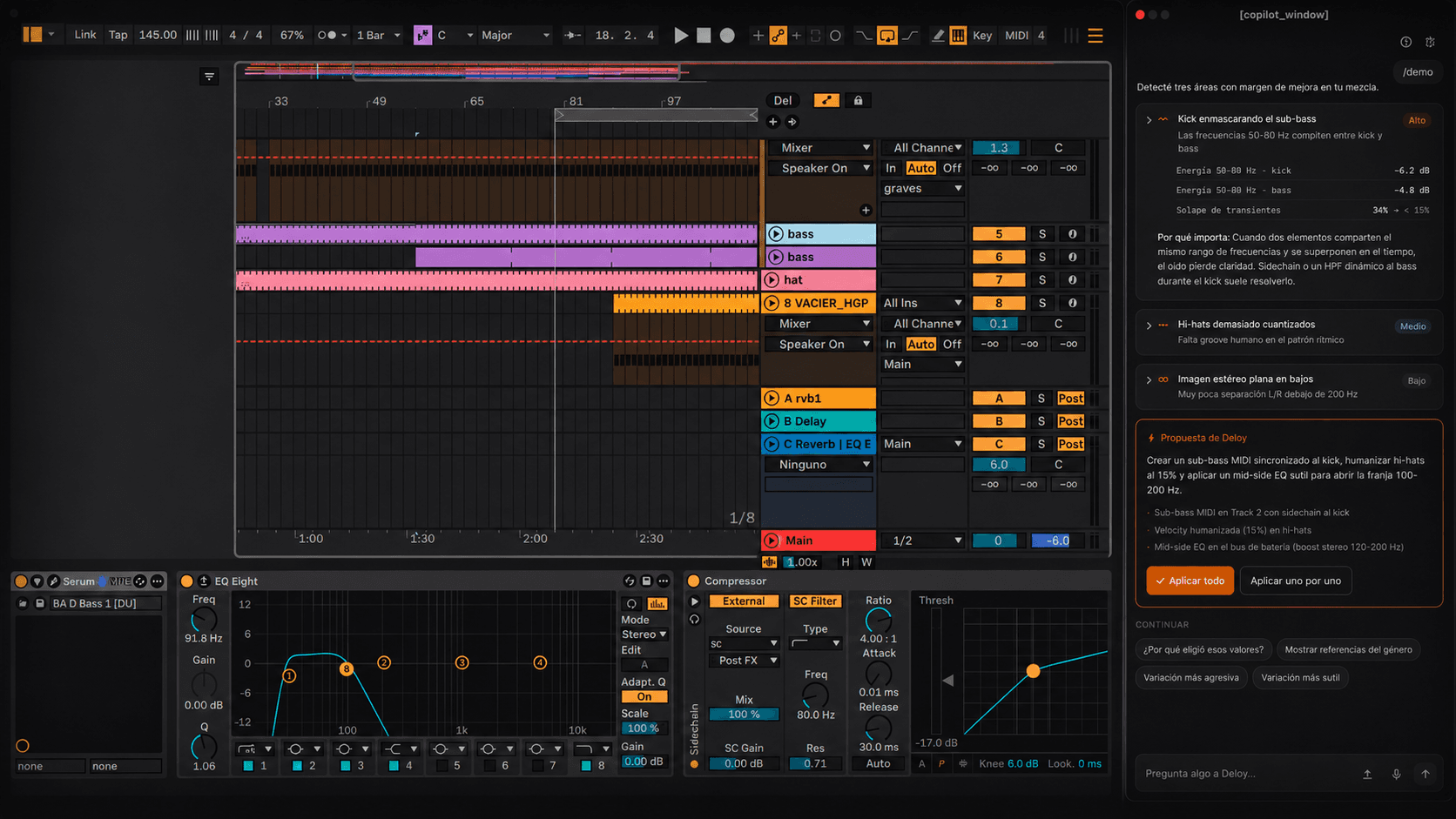
This is where it crosses with what I'm building. I work every day at the most cutting edge of technology, and from there I see fairly clearly that these foundations are being laid now. That's why I build Deloy the way I do: as a copilot that assists the producer inside Ableton, but that leaves a record of every decision —how much the AI put in, how much you put in— and signs that authorship verifiably. Not because it's a nice idea, but because it's exactly where the whole industry is walking.
The Wild West phase is ending. What's coming is the rules phase. And the rule that's winning, on every front at once, is the one that always seemed to me the only defensible one: AI can be in music, with all its power, as long as the human remains the author and that can be proven.
It's not a restriction on creativity. It's the condition for creativity to keep having an owner.
— Cristian
The figures in this article come from public industry reports from 2025 and 2026, including data from MIDiA Research, music creator surveys, generative AI market reports, and the published policies of Spotify, Apple Music, Deezer and Tidal. The court rulings mentioned were pending at the time of writing.